


Dealing With the Past Concepts
Addressing the legacy of a violent past is essential for rebuilding relationships and trust between individuals, communities and states.
Introduction
The term “Dealing with the Past” (DWP) emerged in the 1970s as a distinct field of study and practice, gaining prominence in the 1980s, particularly in the context of transitions to democracy and addressing human rights violations in Latin America and South Africa. It encompasses various measures aimed at constructively addressing past wrongdoings, including truth-seeking, justice mechanisms, and memorialization.
Here’s a more detailed breakdown
1970s:
The “Dealing with the Past” agenda began to take shape, with an emphasis on preventing future atrocities by addressing past harms.
1980s:
The concept gained traction as newly democratic governments in Latin America and South Africa grappled with the legacies of authoritarian rule and human rights abuses. This led to debates about how to balance accountability for past crimes with the need for social reconciliation and stability.
1990s onwards:
“Dealing with the Past” became a more formalized field, with international organizations and NGOs actively promoting its principles and practices in various contexts around the world.
The term “Dealing with the Past” is used to describe a broad range of approaches and activities, including:
Truth-seeking:
Establishing historical facts about past events through investigations, truth commissions, and public hearings.
Right to Justice:
Hold perpetrators accountable, perpetrators of human rights violations, and seek redress for victims of past violations by various judicial and non-judicial means.
Reparation and compensation:
Through the development of programs to identify the needs of victims and compensate them in various material and moral forms.
Non-repetition guarantee:
Reform institutions implicated in past abuses, previous laws and constitutions, strengthen societal peace structures, and address the drivers of conflict.
Memorialization:
Creating public spaces, monuments, and commemorative events to honor victims, acknowledge past suffering, and promote reconciliation.
What Does Dealing With the Past Mean?
- Dealing with the feelings [sad, happy, mad, confuse, comfort, …]
- Dealing with the memories [bad, nice, hard, horrible, …]
- Dealing with the issues [education, security, economic, social, environment, …]
- Dealing with the events [kill, missing, torture, bomb, cut, displacement, kidnapping, …]
- Dealing with the rights [woman, children, citizenship, labor, knowledge, minorities, …]
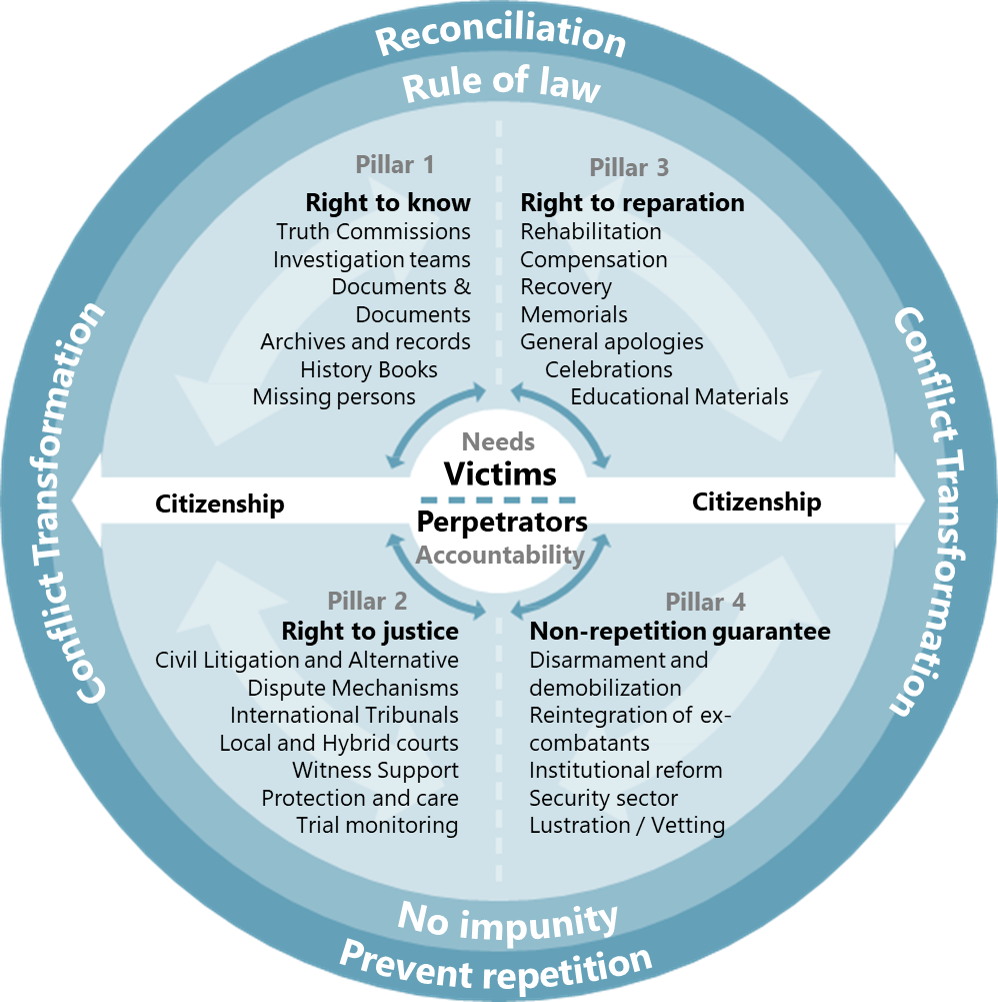
So, dealing with the past pillars is:
- Right to know
- Right to justice
- Right to reparation
- Guarantee of non-recurrence
Contexts Addressed by the Concept of Dealing With the Past
- Human rights violations (social, economic, civil, political and cultural) and violations of international human rights law.
- Internal armed conflicts (and/or) authoritarian regimes. States that have a lack of legitimacy and capabilities, and weak civilian control over security institutions, not independent institutions.
- Rampant corruption, violence and/or the infiltration of organized crime within state institutions, and violence from a gender perspective.
- Communities where victims (civilians) are close to perpetrators at the same time and place.
… To see the full report, use the buttons above to read or download