


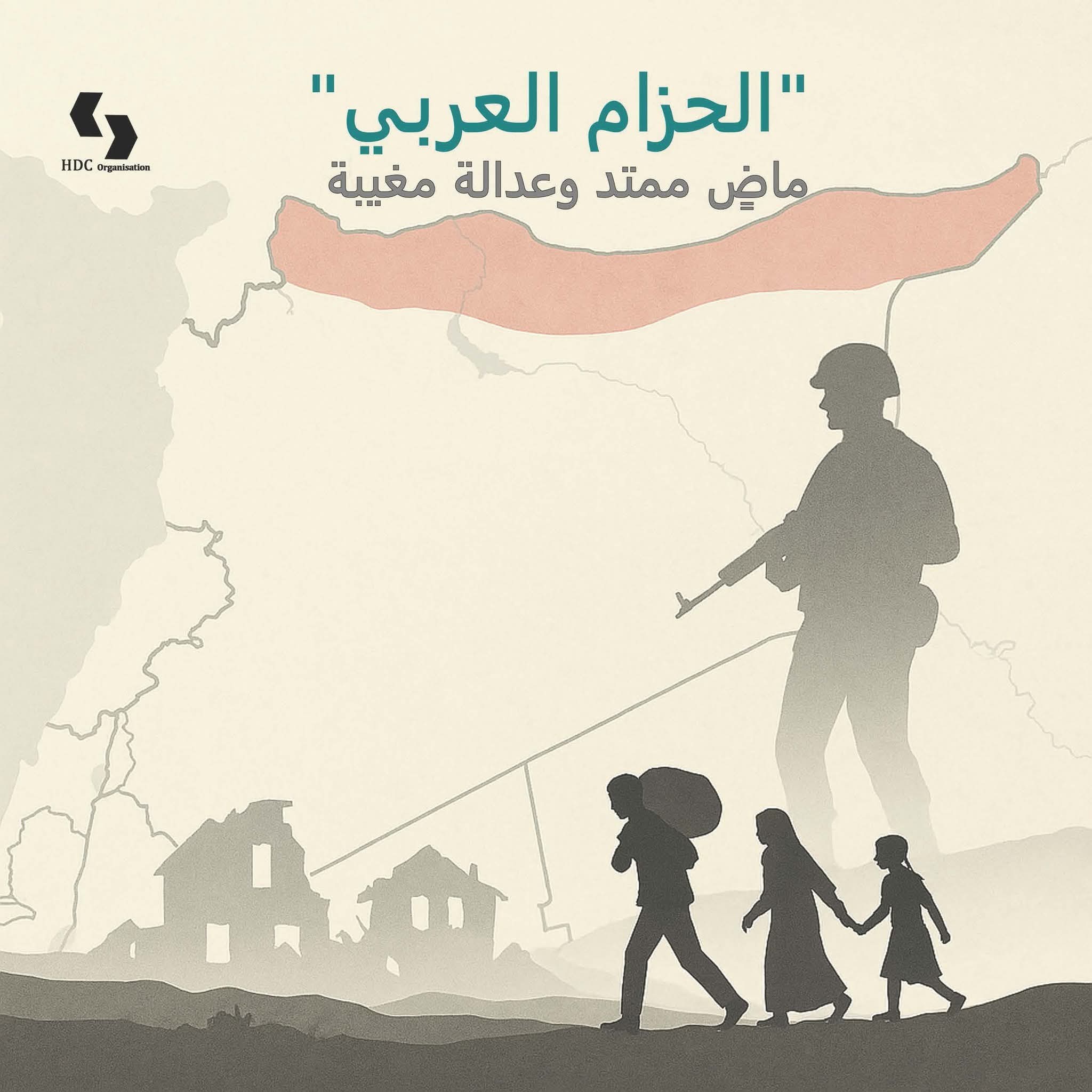
The Arab Belt Project is widely regarded as one of the policies adopted by the Syrian government during the 1970s, particularly beginning in 1973 under the rule of the Ba’ath Party. The project targeted the Syrian Jazira region, predominantly inhabited by Kurds, especially in the areas of Al-Hasakah and Qamishli.
The core objective of the project was to establish a demographic belt of Arab settlers stretching approximately 280 kilometers along the Syrian-Turkish border, with a depth ranging between 10 and 15 kilometers. Arab farming families primarily from Raqqa Governorate, whose lands had been submerged following the construction of the Tabqa Dam and the creation of Lake Assad, were relocated to the region. They were settled on agricultural lands confiscated from Kurdish inhabitants and provided with government support, including land ownership, housing, and infrastructure.
The Arab Belt Project was not merely a housing or resettlement policy; rather, it constituted a systematic and discriminatory demographic engineering project aimed at altering the population structure of the Syrian Jazira, particularly in areas with a Kurdish majority.
The Syrian government first developed plans for the “Arab Belt” in 1965. Beginning in 1973, and pursuant to recommendations issued by the National Security Bureau, the National Leadership of the Arab Socialist Ba’ath Party adopted Resolution No. 521, which paved the way for the implementation of a plan that included:
- The forced displacement of thousands of Kurdish families from their fertile lands along the border with Turkey.
- The relocation of Arab families from their original areas, primarily in Raqqa and Tabqa, where lands had been flooded due to the construction of the Tabqa Dam, and granting them lands and newly built housing on territories belonging to the indigenous population of Jazira.
This policy contributed to social tensions, episodes of violence, and ethnic and communal conflict whose effects remain visible today.
- The issuance of a series of administrative measures that effectively rendered many affected Kurds “illegal residents” (foreigners or unregistered persons), depriving large numbers of Syrian citizenship, as well as the rights to property registration, civil documentation, education, and employment.
- Increased security and military oversight in Kurdish-populated areas, which were classified as “sensitive regions,” thereby reinforcing an environment of surveillance and repression.
In addition, so-called “model villages” were established within what later became known as state farms. These settlements were built on lands confiscated from Kurds and other local inhabitants, either under the pretext of agrarian reform or because the owners had been stripped of their citizenship following the exceptional census conducted in Al-Hasakah in 1962. By 1975, nearly 4,000 Arab families had been settled in 41 model villages, while Kurdish landowners were prevented from returning to their properties, in clear violation of the principles of equality and the right to property.
Long-Term Consequences of the Project:
The project generated profound and enduring consequences across multiple dimensions, including:
- Fragmentation of the social fabric between newly settled populations and the Kurdish community, planting the seeds of tension, polarization, and recurrent patterns of organized violence and ethnic conflict.
- A deep erosion of Kurdish trust in the central state, accompanied by a persistent sense of exclusion and discrimination.
- Economic deprivation resulting from the confiscation of agricultural lands that had constituted the primary source of livelihood for tens of thousands of families, leading to poverty and marginalization.
- Cultural and linguistic marginalization through policies of forced Arabization and restrictions on expressions of Kurdish cultural identity.
- The consolidation of a collective memory of injustice, transforming the project into a symbol of historical grievance and demands for redress.
Dealing with the Past (DwP) and Its Importance for Transitional Justice (TJ)
Ignoring a policy of such magnitude and impact risks excluding a significant segment of Syrian society from processes of reconciliation and reconstruction. Addressing this issue constitutes a critical test of the seriousness and credibility of any future transitional justice process in Syria for several reasons:
- The project directly affected fundamental rights, including land ownership, identity, and citizenship.
- It was linked to systematic policies that persisted over decades rather than isolated incidents.
- Its consequences continue to shape the social and political realities of the region to this day.
The project resulted in forced demographic changes and placed significant pressure on local social cohesion. Official policies deepened the marginalization and vulnerability of the Kurdish population. Kurdish communities were deprived of ownership rights over their lands, while more than 150,000 Syrian Kurds were stripped of their citizenship following the 1962 Al-Hasakah Census, facilitating the confiscation of their properties.
Accordingly, Humanitarian and Development Cooperation (HDC) believes that transitional justice should not be limited to addressing violations committed during periods of armed conflict. Rather, it should encompass a broader approach to confronting both conflict-related abuses and their root causes, including those predating the conflict itself. In this context, the Arab Belt Project represents one of the key structural drivers that must be addressed.
HDC therefore emphasizes the following recommendations as essential pathways and dealing with the past mechanisms toward social reconciliation, social justice, and equal citizenship:
- Integrate the Arab Belt Project as a central component of any peacebuilding and transitional justice process in Syria, recognizing it as a systematic policy that resulted in forced displacement and demographic change, thereby necessitating independent investigations and comprehensive documentation of violations committed against affected populations.
- Support the establishment of specialized and impartial committees to identify all those affected by the project, including displaced Kurdish families and Arab families who were resettled without genuine choice, with the aim of developing equitable and non-discriminatory solutions.
- Advocate for official and public acknowledgment of displacement policies carried out under the project and promote legislation prohibiting ethnic, linguistic, and religious discrimination within a binding constitutional framework.
- Support efforts aimed at restoring rights and property to their lawful owners or providing fair compensation, including recognition of the right of refugees and displaced persons to voluntarily return to their places of origin in conditions of safety and dignity.
- Call for the elimination of the legal and political consequences of discriminatory measures imposed on Syrian Kurds, particularly through addressing the legacy of the 1962 exceptional census and restoring citizenship and full civil rights to those deprived of them.
- Encourage the drafting of a new constitution founded upon equality and equal citizenship, one that enshrines respect for ethnic and cultural diversity and guarantees collective and individual rights without discrimination.
- Contribute to the establishment of independent and impartial legal mechanisms to adjudicate property disputes arising from the project and provide technical support for transparent processes of restitution and reparations in accordance with international transitional justice standards.
- Pursue legislative and institutional reforms to review and amend property laws that were used to legitimize displacement and confiscation under the project, ensuring the restoration of rights to affected communities.
The legacy of the Arab Belt Project remains an unresolved chapter in Syria’s contemporary history. Addressing its consequences through truth, accountability, restitution, and institutional reform is essential for building a just, inclusive, and sustainable peace for all Syrians.